 George El-Hage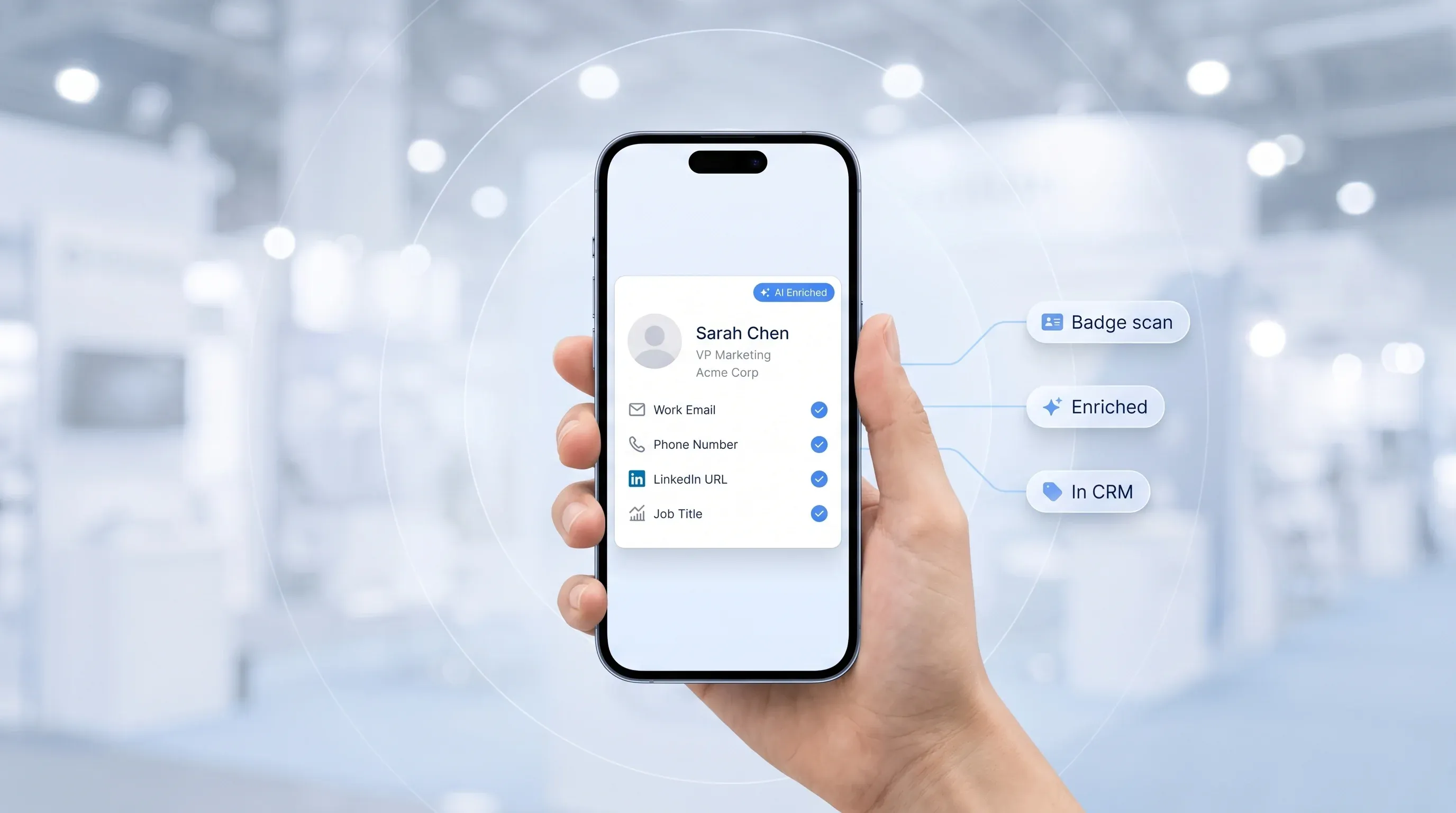
White label lead capture is how an exhibit house puts badge scanning, contact enrichment and CRM sync in front of its clients without building any of it. Your client asks who came to the booth and what it produced, and the answer has to land in their CRM rather than in a spreadsheet two weeks later.
Three things below: what the build actually involves if you do it in house, the one question that decides whether a partner is safe to introduce to your clients, and how revenue share, reseller and white label deals differ once there's a real show on the calendar.
I've spent six years helping teams turn in-person meetings into pipeline. The exhibit houses I talk to tend to reach the same conclusion in the same order. The product side of this sits in event lead capture.
Your clients want proof the booth worked, and the show's own lead retrieval was never built to give them that. Building your own capture app is a real software project, so partnering is the realistic move. But the partner has to pass one test before a single feature matters: it must not compete with you for the same client. After that, the deal shape follows who does the onboarding.
Why your clients now ask for KPIs from the booth
Ten years ago the debrief after a show was about the space. Did the structure land, did the traffic flow work, did the client's team have what they needed. That conversation still happens. It's just no longer the one that decides next year's budget.
What decides it now is a number.
Marketing has to attribute event spend the same way it attributes everything else, so the booth has to produce records a CRM can hold. Sales wants those leads while the show is still running, with enough context to know who's worth a call on Monday.
Your client isn't asking you for a scanner. They're asking you to close the gap between the conversation at the counter and the follow-up after it, and to hand them something they can measure the return on.
A rented scanner doesn't close that gap. It produces a file of registration fields after the show, usually without the notes the reps took, and nothing in it reaches the client's CRM on its own. Someone uploads it the following week, by which point the leads have cooled and the attribution argument is already lost.
Build it or partner: what the build actually involves
Most houses price this build once and never price it again.
The visible part is a scanner. Point a phone at a badge, read the name. That part is a weekend. The rest is the product:
- Reading badges reliably across every layout, font, lanyard twist and lighting condition a show floor produces.
- An enrichment stack that turns a name and a company into a verified email, phone, title and LinkedIn profile, with more than one data source behind it so the answer isn't blank half the time.
- A CRM integration per client, with field mapping, because your clients don't all use the same CRM and none of them want their fields renamed.
- Offline capture, because convention centre wifi is convention centre wifi.
- User management, permissions and a dashboard somebody has to maintain.
- Support at 7am on show day when a rep can't sign in.
That last one is where most houses stop. You can hire the first five. The sixth is a commitment every show weekend, permanently. So the real question isn't build versus buy. It's whether you want to be in the software business alongside the business you're already in.
The one test that matters: does the vendor compete with you?
Before you compare a single feature, ask the vendor one question. Do you also design, build or produce booths?
I watched this decide an evaluation recently. An exhibit house had shortlisted a lead capture provider that also builds experiences. Every introduction that house made would have put a competitor in front of its own client, with a reason to be in the room and a relationship forming. The features were fine. The answer to that question wasn't.
Ask it in writing, with two follow-ups. Here's what to listen for:
| What to ask | A good answer sounds like | A warning sign |
|---|---|---|
| Do you build or produce booths? | No, we only make software | Any version of 'we also do experiences' |
| Will you sell direct to a client I introduce? | Not without you in the room | It depends, or a change of subject |
| Can we register accounts in writing? | Yes, deal registration and named-account carve-outs | We'll handle it informally |
Wave Connect makes software. We don't design booths, we don't produce events and we don't rent hardware, so there's nothing for us to cross-sell into your client relationship.
Why the show's own lead retrieval doesn't solve it
The official lead retrieval vendor isn't the problem here. It owns the show's registration database, so it can hand back whatever attendees typed into the organizer's signup form before the doors opened.
Worth being precise about what that is: the organizer's questions, asked weeks earlier. Not your client's questions, asked at the stand. Those are a separate thing, and they get asked at the booth either way.
What it doesn't do is follow your client from show to show. It's bought per event, from that event's registration vendor, at rates that ran $350 to $735 per rep on 2026 order forms at major US shows.
Some shows also sell an API key, often called a developer kit or an event API, that lets an outside app query that show's registration data. It has to be bought and integrated for each event separately.
| The show's official retrieval | A capture app like ours | |
|---|---|---|
| How your client gets it | Ordered per show from that show's vendor | Installed once, used everywhere |
| Where it works | That show | Any show, plus paper cards and QR codes |
| What comes back | The attendee's registration record | An enriched contact with verified email, phone, title and LinkedIn |
| Registration screening answers | Yes, they own that database | No |
| Your client's own questions | Asked at the booth | Asked at the booth |
| How it reaches the CRM | Usually a file to import after the show | Synced in real time, with the rep's notes |
Rental rates from published 2026 exhibitor order forms at major US shows.
For a client exhibiting at nine shows a year, that's nine procurement conversations, nine data formats, and nine separate answers to whether anything reaches their CRM.
What a partner-ready lead capture product needs
Whatever you end up recommending, these are the things that matter once the product has to work across your whole client roster instead of at one show:
- Works at any show, without the organizer. The AI Badge Scanner reads the name and company printed on the badge, so there's no key to buy and nothing to activate before the doors open. The same tool works at the show that sells a developer kit and at the show that sells nothing at all.
- Leads come back complete. Waterfall Lead Enrichment takes that name and company and checks multiple independent data sources in sequence for a verified business email, phone number, job title and LinkedIn profile. When nothing is found, no credit is used.
- Real-time CRM sync with per-client field mapping. HubSpot, Salesforce, Zoho, Microsoft Dynamics 365, Pipedrive, HighLevel and Outlook contacts are native, Zapier covers anything else, and CSV export is always available. Your client's custom fields stay their custom fields.
- Everyone at the booth is included. Pricing is per lead, so there are no per-user fees. The whole team captures from a shared balance, including the brand ambassadors and temporary staff who are only on the stand for three days.
- Offline capture. Scanning and note taking work without a signal. Enrichment and CRM sync run as soon as the connection comes back.
- Your client's questions, asked at the booth. Custom qualifiers capture interest level, product line or follow-up owner, and every capture is tagged to the event automatically.
If you want the exhibitor-side version of this list to hand a client, how to capture leads at a trade show covers the same ground from their seat, and Wave Connect's badge scanner goes deeper on the capture itself.
See it against your own show calendar
Bring a client roster and a couple of upcoming shows, and we'll walk through what capture, enrichment and CRM sync would actually look like on those stands.
Book a callRevenue share, reseller or white label: which fits your house
Three shapes, and they differ less in price than in who does the work:
| Revenue share | Reseller | White label | |
|---|---|---|---|
| Who signs the client | Wave Connect | Your house | Your house |
| Whose brand the client sees | Wave Connect | Both | Yours |
| Who onboards and supports | Wave Connect | Shared | Your team, with us behind you |
| Who bills | Wave Connect | Your house | Your house |
| How your house earns | A share of what your client spends | Margin on what you sell | Margin, and the client relationship stays yours |
| Best for | Recommending it on a handful of accounts | Putting it on the proposal as a line item | Houses running their own client services team |
The honest answer is that it follows the onboarding.
If your account team will set up the client's event, map their CRM fields and take the call when something goes wrong on the floor, white label makes sense and the economics should reflect that work. If you'd rather recommend the product and stay out of the middle, a revenue share is simpler and starts faster.
We work with partners on all three. Terms get set on a call rather than published on a page, because the right structure for a house doing two shows a quarter isn't the right structure for one running fifty.
Can we white label it?
Yes, for the right partner, and typically one that runs its own client onboarding.
In practice: your client signs with you, logs into a dashboard carrying your brand, and gets reports with your name on them. Your team does the setup and the first line of support. Wave Connect runs the platform, the enrichment and the technical support behind you.
What's branded and what isn't is worth twenty minutes on a call rather than a guess from a pricing page.
One disambiguation, because the phrase is overloaded. A white label event app usually means a branded agenda app for attendees. This isn't that. This is lead capture and enrichment for the booth, and the two solve different problems for different buyers.
What it looks like on show day
Set up the event and the qualifiers
You create the client's event in the dashboard and add the questions their sales team wants asked at the stand: interest level, product line, who follows up.
Get the team on the app
Reps, brand ambassadors and temporary staff install the app and sign in. There are no per-user fees, so who stands at the counter is a staffing decision rather than a licensing one.
Capture at the counter
A rep photographs the badge and the scanner reads the printed name and company. The rep adds a note or a voice note while the conversation is still fresh, and tags the qualifiers.
Leads enrich and sync during the show
Each capture runs through the enrichment waterfall and lands in the client's CRM with the contact details, the notes and the event tag attached. Sales can work the good ones on day one instead of the following week.
Hand over the numbers
You pull the event view for the debrief: how many leads, by rep, by qualifier, with the CRM records behind every figure.
Where it doesn't fit
Three situations where I'd tell you this is the wrong recommendation.
| The situation | What's going on | What to recommend |
|---|---|---|
| The show mandates its own device | A few large vendor-run conferences prohibit outside capture apps in the exhibitor terms | Read your client's exhibitor agreement first, and use the official product at that show |
| The client wants pre-show registration answers | Only the show's vendor can return what an attendee typed into the organizer's signup form | Run both: official retrieval for that data, us for capture, enrichment and CRM sync |
| The brief calls for physical interaction tracking | Knowing which demo station someone touched, or RFID on products, is a different category of system | A rep can tag it by hand; specify a tracking vendor if it's core |
Be precise with your client on the middle one. Their own qualifying questions are covered: custom qualifiers let reps ask anything at the booth, and the answers travel with the lead into the CRM. It's only the organizer's pre-show form data that sits elsewhere.
Questions exhibit houses ask
Weighing this for a client roster rather than a single show? The lead capture tools built for trade shows comparison covers the landscape, and connecting Wave Connect to HubSpot and the Salesforce integration show what the sync looks like in practice.
When you want the partner conversation, Wave Connect's event lead capture team can walk through the three models against your own show calendar.
Two companion pieces if you want the rest of the picture: what to ask before partnering with a lead capture vendor is the twelve-question version of this, and lead capture for event organizers covers the same ground from the show organizer's side of the table.
If you'd rather talk it through than read three deal shapes off a table, book a 20 minute call with us and bring one client and one upcoming show.
Talk to us about a partnership
We'll walk through revenue share, reseller and white label against your client roster and your show calendar, and tell you which one actually fits.
Book a callRental rates verified against 2026 exhibitor order forms. Product facts verified 2026-09-28.