George El-Hage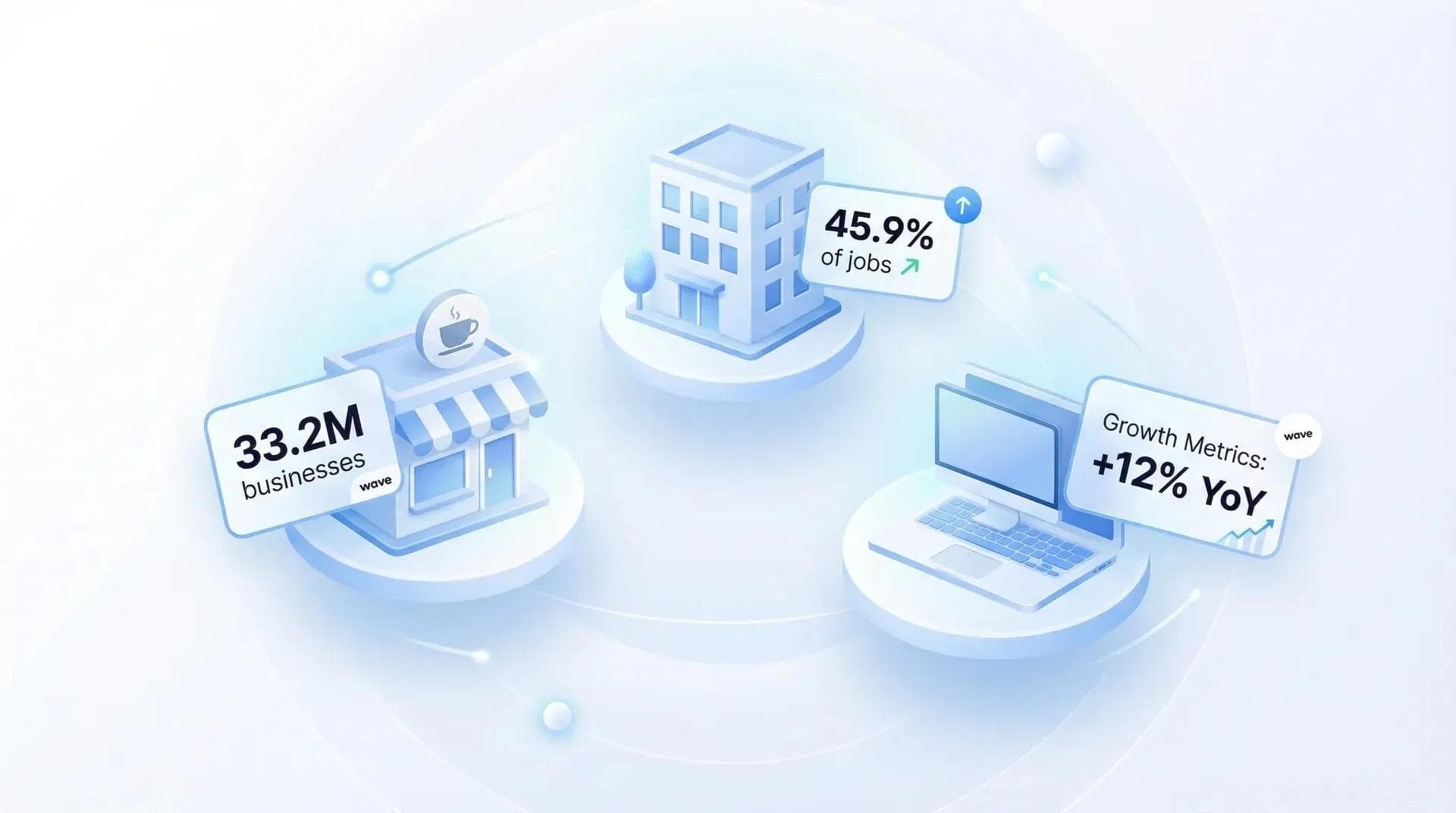
Small business statistics paint a picture of the US economy that most people don't fully appreciate: 36.2 million small businesses employing nearly half the private workforce, generating 43.5% of GDP, and filing over half a million new applications every single month. Whether you're writing a business plan, pitching investors, or just curious about the landscape, these are the numbers that matter.
I've compiled 70+ small business stats from the SBA, Bureau of Labor Statistics, US Census Bureau, Federal Reserve, and a dozen other sources. Every number is cited with its original source so you can use them in your own reports, presentations, or content. Let's dig in.
There are 36.2 million small businesses in the US (99.9% of all businesses), employing 62.3 million people and generating 43.5% of GDP. The failure rate is 20.4% in year one and 49.4% within five years. For 2026, 94% of owners project growth (an all-time high), 56% now use AI, and 79% anticipate revenue increases. Inflation (31%) and cash flow (29%) remain the top challenges.
- The big picture: How many small businesses exist in the US and how fast new ones are forming
- Employment and economic impact: Jobs created, payroll share, and GDP contribution
- Failure and survival rates: Year-by-year breakdown with industry comparisons
- Revenue and funding: Profitability data, lending approval rates, and capital sources
- 2026 outlook: Owner confidence, growth projections, and the challenges they're facing
- Technology and AI adoption: How many small businesses are using AI and what they're using it for
- Demographics and industry breakdown: Who owns small businesses and which industries lead
How Many Small Businesses Are in the US? (The Big Picture)
There are 36.2 million small businesses in the United States as of 2026, representing 99.9% of all US businesses. That includes both employer firms (those with at least one employee) and non-employer firms (sole proprietors, freelancers, and independent contractors). The SBA defines "small business" as any firm with fewer than 500 employees, which covers everything from a solo consultant working from home to a 400-person regional manufacturer. That's roughly one small business for every 10 Americans.
- 36.2 million small businesses in the US (SBA Office of Advocacy, 2024)
- 99.9% of all US businesses are small businesses (SBA Office of Advocacy, 2024)
- 33.2 million are non-employer firms (no paid employees), while roughly 3 million are employer firms (SBA Office of Advocacy, 2024)
- 532,319 new business applications filed in January 2026 - a 7.2% increase month-over-month (US Census Bureau Business Formation Statistics, 2026)
- California leads with approximately 4.2 million small businesses, followed by Texas (3.1M), Florida (3.0M), and New York (2.3M) (SBA Office of Advocacy, 2024)
- 5.5 million new business applications were filed in 2023, marking the third consecutive year above 5 million (US Census Bureau, 2024)
- The average small business has been operating for 12 years (SBA Office of Advocacy, 2024)
That 532,319 applications in January 2026 alone is striking. For context, monthly applications were running around 200,000-250,000 pre-pandemic. We've basically doubled the rate of business formation since 2019, and it's showing no signs of slowing down. If you're curious about which states are leading the charge, check out our breakdown of the most entrepreneurial states in America.
Small Business Employment Statistics
Small businesses employ 62.3 million people in the United States, accounting for 45.9% of the entire private sector workforce. They also pay 38.7% of total private sector payroll and contribute an estimated 43.5% of US GDP. These aren't background players in the economy - they ARE the economy. But the employment picture in 2026 is complicated: hiring is strong, but retention and talent attraction are becoming serious pain points.
- Small businesses employ 62.3 million people - 45.9% of private sector employment (SBA Office of Advocacy, 2024)
- Small businesses pay 38.7% of total private sector payroll (SBA Office of Advocacy, 2024)
- Small businesses contribute 43.5% of US GDP (SBA Office of Advocacy, 2024)
- Small business job growth index at 99.30 in January 2026, indicating slight contraction from the 100-baseline (Paychex Small Business Employment Watch, Jan 2026)
- Hourly earnings growth for small business employees has been below 3% since November 2024 (Paychex Small Business Employment Watch, Jan 2026)
- Employee retention is now a top challenge for 17% of small business owners, up from 12% year-over-year (OnDeck/Ocrolus Small Business Report, Q4 2025)
- Talent attraction concerns doubled to 14%, up from 6% the previous year (OnDeck/Ocrolus Small Business Report, Q4 2025)
- Small businesses created 12.9 million net new jobs over the past 25 years (SBA Office of Advocacy, 2024)
The retention number (17%, up from 12%) is one to watch. For years, the conversation around small business hiring was "we can't find people." Now it's shifting to "we can't keep them." Hourly earnings growth below 3% might explain part of it - if small businesses can't compete on pay, they're losing talent to larger firms that can. That 14% jump in talent attraction concerns (from 6%) basically tells the same story from a different angle.
For more on the broader business environment, see our roundup of general business statistics.
Small Business Failure and Survival Rates
About 20.4% of small businesses fail within their first year, and 49.4% don't make it past five years. By the 10-year mark, roughly 65.3% have closed. These numbers come from Bureau of Labor Statistics data tracking business establishments over time. The two most common reasons for failure? Running out of capital (38%) and insufficient market demand (35%). Not bad products. Not bad people. Just cash and timing.
- 20.4% of small businesses fail in their first year (Bureau of Labor Statistics, 2024)
- 49.4% fail within 5 years (Bureau of Labor Statistics, 2024)
- 65.3% fail within 10 years (Bureau of Labor Statistics, 2024)
- Only 25% of small businesses survive 15 or more years (Bureau of Labor Statistics, 2024)
- 38% of small businesses fail because they run out of capital or can't secure additional funding (CB Insights, 2024)
- 35% fail due to insufficient market demand - "no market need" for their product or service (CB Insights, 2024)
- 23% fail due to team-related issues (wrong hires, co-founder conflicts, lack of expertise) (CB Insights, 2024)
- 19% fail because they get outcompeted (CB Insights, 2024)
Survival Rates by Industry
Not all industries fail at the same rate. Here's how survival rates compare after 5 years:
| Industry | 1-Year Survival | 5-Year Survival | 10-Year Survival |
|---|---|---|---|
| Healthcare & Social Assistance | 85% | 60% | 40% |
| Finance & Insurance | 84% | 58% | 39% |
| Professional & Technical Services | 82% | 55% | 37% |
| Real Estate | 81% | 53% | 36% |
| Manufacturing | 80% | 52% | 35% |
| Retail Trade | 78% | 47% | 31% |
| Construction | 77% | 44% | 30% |
| Transportation & Warehousing | 75% | 40% | 26% |
| Accommodation & Food Services | 72% | 38% | 22% |
Source: Bureau of Labor Statistics Business Employment Dynamics, 2024. Rates are approximate and vary by year of establishment.
Restaurants and food service have the toughest odds - only 38% survive five years. Healthcare has the best. Makes sense when you think about it: healthcare demand is consistent and growing. Restaurant demand is fickle, margins are razor-thin, and competition is brutal.
💡 As someone who started a small business in 2020: That "38% fail from running out of capital" stat hits close to home. In the early days of Wave Connect, cash flow management wasn't just a challenge - it was the challenge. Most small business owners I talk to say the same thing. It's not that the idea was bad. It's that the runway was too short.
Small Business Revenue and Financial Data
46% of small firms with employees reported earning a profit in 2023, while 65% describe their overall business health as "good" or "very good" heading into 2026. The financial picture is complicated: profitability is stable but not universal, revenue projections are optimistic (79% expect growth), and access to capital varies dramatically depending on where you look for it. Small community banks approve more than half of loan applications, while online lenders approve less than a third.
- 46% of small firms with employees earned a profit in 2023 (Federal Reserve Small Business Credit Survey, 2024)
- 65% of small business owners describe their business health as good or very good (US Chamber of Commerce Small Business Index, Q1 2025)
- 79% of small businesses anticipate revenue growth in 2026, with an average projected increase of 7.9% (Comerica Small Business Pulse Index, 2025)
- 57% plan capital expenditures in 2026, averaging $109,000 per business (Comerica Small Business Pulse Index, 2025)
- Average small business revenue: approximately $44,000-$53,000 per year for non-employer firms (US Census Bureau Nonemployer Statistics, 2023)
- Average employer small business revenue: roughly $1.2 million per year (varies widely by industry and size) (SBA Office of Advocacy, 2024)
- Small banks have the highest full-approval rate for small business loans at 54% (Federal Reserve SBCS, 2024)
- Large banks approve approximately 45% of small business loan applications (Federal Reserve SBCS, 2024)
- Online lenders have the lowest full-approval rate at roughly 30% (Federal Reserve SBCS, 2024)
The gap between small bank approval (54%) and online lender approval (30%) is bigger than most people realize. Small community banks know their local businesses. They've seen the owner at the chamber of commerce meetings. That relationship-based lending model still has a massive approval advantage over algorithm-driven online platforms.
If you're thinking about how digital business cards for sales teams fit into these revenue trends, there's a direct connection: small businesses that invest in client-facing tools tend to see faster revenue growth.
Small Business Confidence and Outlook for 2026
A record 94% of small business owners project growth in 2026, the highest level ever recorded in the OnDeck/Ocrolus survey. That's not just optimism - it's borderline unanimous. Other surveys back it up: 80% describe themselves as confident in their future success, and 60%+ feel more positive about their business than at any point in the past five years. The post-pandemic hangover appears to be fully over.
- 94% of small business owners project growth in 2026 - an all-time survey high (OnDeck/Ocrolus Small Business Report, Q4 2025)
- 80% of small business owners describe themselves as confident in future success (Comerica Small Business Pulse Index, 2025)
- 60%+ of business leaders feel more positive than at any point in the past 5 years (JPMorgan Business Leaders Outlook, 2026)
- Small Business Index sits at 68.4 (Q4 2025), maintaining elevated levels since mid-2024 (MetLife/US Chamber Small Business Index, Q4 2025)
- 57% of small businesses plan to hire in 2026 (OnDeck/Ocrolus Small Business Report, Q4 2025)
- 48% plan to increase employee compensation in 2026 (OnDeck/Ocrolus Small Business Report, Q4 2025)
94% projecting growth. Let that sink in for a second. In 2020, that number was around 50%. In 2022, it was climbing back to the mid-70s. Now it's pushing the ceiling. The question isn't whether small business owners are optimistic - it's whether the economy can actually deliver on that optimism given the challenges they still face (more on that below).
Top Challenges Facing Small Businesses in 2026
Inflation remains the number-one challenge for small businesses at 31%, followed closely by cash flow at 29%. Despite the record-high confidence numbers, the day-to-day reality for small business owners still involves managing rising costs, thinning margins, and unpredictable supplier pricing. The data shows they're adapting - building cash reserves, renegotiating contracts - but the pressure hasn't gone away.
- Inflation is the #1 challenge: 31% of small business owners cite it as their top concern (OnDeck/Ocrolus Small Business Report, Q4 2025)
- Cash flow is #2 at 29% (OnDeck/Ocrolus Small Business Report, Q4 2025)
- 58% of small businesses expect to raise prices due to inflation (OnDeck/Ocrolus Small Business Report, Q4 2025)
- 52% expect less revenue as a direct result of inflation (OnDeck/Ocrolus Small Business Report, Q4 2025)
- Employee retention concerns at 17%, up from 12% the previous year (OnDeck/Ocrolus Small Business Report, Q4 2025)
- 47% are building cash reserves as an inflation hedge (OnDeck/Ocrolus Small Business Report, Q4 2025)
- 36% are renegotiating supplier terms to manage costs (OnDeck/Ocrolus Small Business Report, Q4 2025)
- 23% cite supply chain issues as a continuing challenge (US Chamber of Commerce, Q4 2025)
- 18% report that government regulations and compliance are a top concern (US Chamber of Commerce, Q4 2025)
Here's the tension in the data: 94% project growth, but 58% plan to raise prices and 52% expect less revenue from inflation. Those two things can both be true. Owners are optimistic about the direction of travel, but they're realistic about the headwinds. Building cash reserves (47%) and renegotiating supplier terms (36%) aren't signs of panic - they're signs of experience.
The networking statistics we track tell a similar story. Small business owners are investing more in relationship-building and lead generation tools, even as they tighten budgets elsewhere. The money follows the ROI.
Small Business Technology and AI Adoption
56% of small businesses now report using AI in their operations, and among those AI users, 87% say it's had a positive impact on their business. This isn't a "big company" phenomenon anymore. More than half of small businesses have adopted AI tools, primarily for marketing (63% of users), customer service, and basic data analysis. JPMorgan data shows 59% of business leaders see AI as essential within the next three years.
- 56% of small businesses report using AI (OnDeck/Ocrolus Small Business Report, Q4 2025)
- Among AI users, 63% use it for marketing (content creation, social media, email campaigns) (OnDeck/Ocrolus Small Business Report, Q4 2025)
- 87% of small business AI users report a positive business impact (OnDeck/Ocrolus Small Business Report, Q4 2025)
- 59% of business leaders see AI as essential within 3 years (JPMorgan Business Leaders Outlook, 2026)
- 53% of SMBs have adopted AI tools according to a separate survey (US Chamber of Commerce/GoZoek, 2025)
- 44% of small businesses use AI for customer service (chatbots, automated responses) (OnDeck/Ocrolus, Q4 2025)
- 37% use AI for data analysis and business intelligence (OnDeck/Ocrolus, Q4 2025)
- 29% use AI for bookkeeping and financial management (OnDeck/Ocrolus, Q4 2025)
The marketing use case at 63% doesn't surprise me at all. Small business owners don't have marketing departments. They're the marketing department. AI tools that write social captions, generate email copy, and create ad variations are saving them hours every week. That's not hype - that's practical utility.
The broader story here is that small businesses are adopting technology at rates we haven't seen before. It's not just AI either. Digital tools across the board - from digital business cards to automated CRM systems - are becoming standard operating procedure for small firms.
Small Business Statistics by Industry
Retail trade (16%), food and accommodation (13%), and health and beauty services (12%) are the three largest small business industries by count. But size doesn't equal confidence. Technology firms report the highest optimism (93% project growth), followed by healthcare (90%). The fastest-growing categories for new business formation are professional services, e-commerce, and health-related services.
- Retail trade accounts for 16% of all small businesses (Guidant Financial Small Business Trends, 2025)
- Food and accommodation: 13% of small businesses (Guidant Financial, 2025)
- Health, beauty, and fitness services: 12% (Guidant Financial, 2025)
- Business services and consulting: 11% (Guidant Financial, 2025)
- Technology firms report the highest confidence: 93% project growth in 2026 (OnDeck/Ocrolus, Q4 2025)
- Healthcare small businesses: 90% project growth (OnDeck/Ocrolus, Q4 2025)
- Professional services (legal, accounting, engineering) have among the highest 5-year survival rates at 55% (Bureau of Labor Statistics, 2024)
- Home-based businesses account for more than 60% of all small businesses (SBA Office of Advocacy, 2024)
The home-based business number (60%+) often surprises people. Most small businesses don't have a storefront or office. They're run from spare bedrooms, kitchen tables, and home offices. That completely changes how these owners think about tools, networking, and client acquisition. Everything has to be digital-first because there's no physical location for walk-in business.
Whether business cards are still relevant for these industries is a question we've explored in depth. Short answer: yes, but the format is changing fast. Read more on whether business cards are still relevant in 2026.
Small Business Ownership Demographics
75% of small business owners in the US are male, 78% are White, and Gen X and Baby Boomers together account for approximately 70% of all ownership. But the demographic mix is shifting. Millennials now represent 21% of small business owners and growing, women-owned businesses are the fastest-growing segment, and minority-owned businesses increased 40% between 2017 and 2022. The "typical" small business owner profile is slowly diversifying.
- 75% of small business owners are male (Guidant Financial, 2025)
- 78% of small business owners are White (Guidant Financial, 2025)
- Gen X (ages 44-59) is the largest ownership cohort, followed by Baby Boomers (60+) (Guidant Financial, 2025)
- Millennials represent 21% of small business owners and growing (Guidant Financial, 2025)
- 29% say "being their own boss" is the top motivation for starting a business (Guidant Financial, 2025)
- Women-owned businesses grew at approximately 2x the rate of all businesses from 2017-2022 (US Census Bureau Annual Business Survey, 2023)
- Minority-owned businesses increased 40% between 2017 and 2022 (US Census Bureau Annual Business Survey, 2023)
- 62% of small business owners have a college degree or higher (Guidant Financial, 2025)
"Being their own boss" at 29% as the top motivation - that tracks with everything I've seen. It's not about getting rich. It's about autonomy. Dissatisfaction with corporate America, flexibility for family, and the desire to control your own schedule are the real drivers. Money matters, of course, but it's rarely reason number one.
The Millennial ownership number (21%) is interesting in context. Millennials are now in their late 20s to early 40s - prime business-starting age. That percentage will keep climbing, and it's already reshaping how small businesses approach personal branding and digital presence.
Small Business Funding and Capital Statistics
Credit cards are the number-one capital source for young businesses (under 2 years old), while small community banks maintain the highest loan approval rate at 54%. The funding landscape for small businesses in 2026 is fragmented. Traditional banks, online lenders, credit lines, SBA loans, and personal savings all play a role. Where you look for money matters almost as much as how much you need.
- Credit cards are the #1 capital source for businesses under 2 years old (Federal Reserve SBCS, 2024)
- Small banks: 54% full approval rate for small business loan applications (Federal Reserve SBCS, 2024)
- Large banks: approximately 45% full approval rate (Federal Reserve SBCS, 2024)
- Online lenders: approximately 30% full approval rate (Federal Reserve SBCS, 2024)
- 74% of businesses that chose non-bank lenders did so for speed of decision and funding (Federal Reserve SBCS, 2024)
- Personal savings fund approximately 77% of small business startups (Guidant Financial, 2025)
- Average SBA 7(a) loan amount: approximately $479,000 in FY2024 (SBA, 2024)
That 74% number for speed-of-funding is telling. Online lenders approve fewer applications, but the ones they do approve get funded fast - sometimes within 24-48 hours. Traditional banks take weeks. So business owners are making a calculated trade-off: lower approval odds in exchange for speed when cash flow is on the line.
Personal savings at 77% is the stat that never gets enough attention. Most small businesses aren't funded by venture capital or even bank loans. They're funded by the owner's savings account. That's real risk, real skin in the game.
💡 From my own experience: When I started Wave Connect, it was personal savings and credit cards. No VC round, no SBA loan. That's the reality for most small businesses - you fund it yourself until the business can fund itself. The Federal Reserve data confirms what most founders already know: outside capital is hard to get early on.
Wave Perspective: What These Stats Mean for Small Business Networking
36.2 million small businesses generate a massive amount of networking activity - from sales meetings and industry events to local chamber meetups and online outreach. The data in this article paints a clear picture: small businesses are growing, adopting technology at record rates, and investing in tools that help them compete. Here's what that means from where I sit.
I built Wave Connect as a small business. I'm one of those 36.2 million. So when I read that 56% of small businesses now use AI and 60%+ are home-based, I don't see abstract data points - I see the people I work with every day. These are founders running lean, working from home, and needing every client interaction to count.
Consider this: 88% of paper business cards get thrown away within a week. Meanwhile, the technology adoption numbers (56-59% AI usage, record-high digital tool adoption) show that small business owners are ready for better solutions. They're already using digital tools for marketing, customer service, and finance. Networking and contact sharing are the next frontier.
Home-based businesses (60%+) don't have a storefront where clients walk in. They meet people at events, through referrals, and online. A digital business card isn't a nice-to-have for these businesses - it's how they make first impressions that actually stick.
💡 What I see daily: The small business owners who use Wave Connect aren't tech companies. They're real estate agents, insurance brokers, consultants, and contractors. The same people represented in these statistics. They switched from paper because they got tired of handing someone a card and never hearing back. Digital gives them tracking, follow-up, and a profile that stays updated. That's not a sales pitch - that's what 200,000+ professionals have actually done.
Frequently Asked Questions
How many small businesses are there in the US in 2026?
There are 36.2 million small businesses in the US, representing 99.9% of all businesses. This includes both employer firms and non-employer sole proprietors.
What percentage of small businesses fail in the first year?
About 20.4% of small businesses fail in their first year. By year five, 49.4% have closed, and by year ten, 65.3% are gone.
What is the most common reason small businesses fail?
Running out of capital is the top reason at 38%, followed by insufficient market demand at 35%. Team issues (23%) and competition (19%) are the next most common causes.
What percentage of jobs do small businesses create?
Small businesses employ 62.3 million people, which is 45.9% of total US private sector employment. They also account for 38.7% of private sector payroll.
What is the average revenue of a small business?
Non-employer small businesses average $44,000-$53,000 per year, while employer small businesses average roughly $1.2 million. Revenue varies widely by industry and firm size.
How many small businesses use AI in 2026?
56% of small businesses now report using AI, primarily for marketing (63%), customer service (44%), and data analysis (37%). Among AI users, 87% report a positive business impact.
What industry has the highest small business survival rate?
Healthcare and social assistance has the highest 5-year survival rate at approximately 60%. Finance and insurance (58%) and professional services (55%) are close behind.
Are small businesses optimistic about 2026?
Yes - 94% of small business owners project growth in 2026, the highest level ever recorded. 80% describe themselves as confident, and 60%+ feel more positive than at any point in the past five years.
Join 36 Million Small Businesses Going Digital
Small businesses are adopting digital tools at record rates. Start with the one your prospects actually keep - a digital business card with instant sharing, analytics, and zero app downloads.
Create My Free CardAbout the Author: George El-Hage is the Founder of Wave Connect, an event lead capture platform with a full digital business card built in, serving 200,000+ professionals worldwide. As a small business owner since 2020, George tracks small business and networking trends as part of Wave Connect's ongoing market research. Connect with him on LinkedIn.