George El-Hage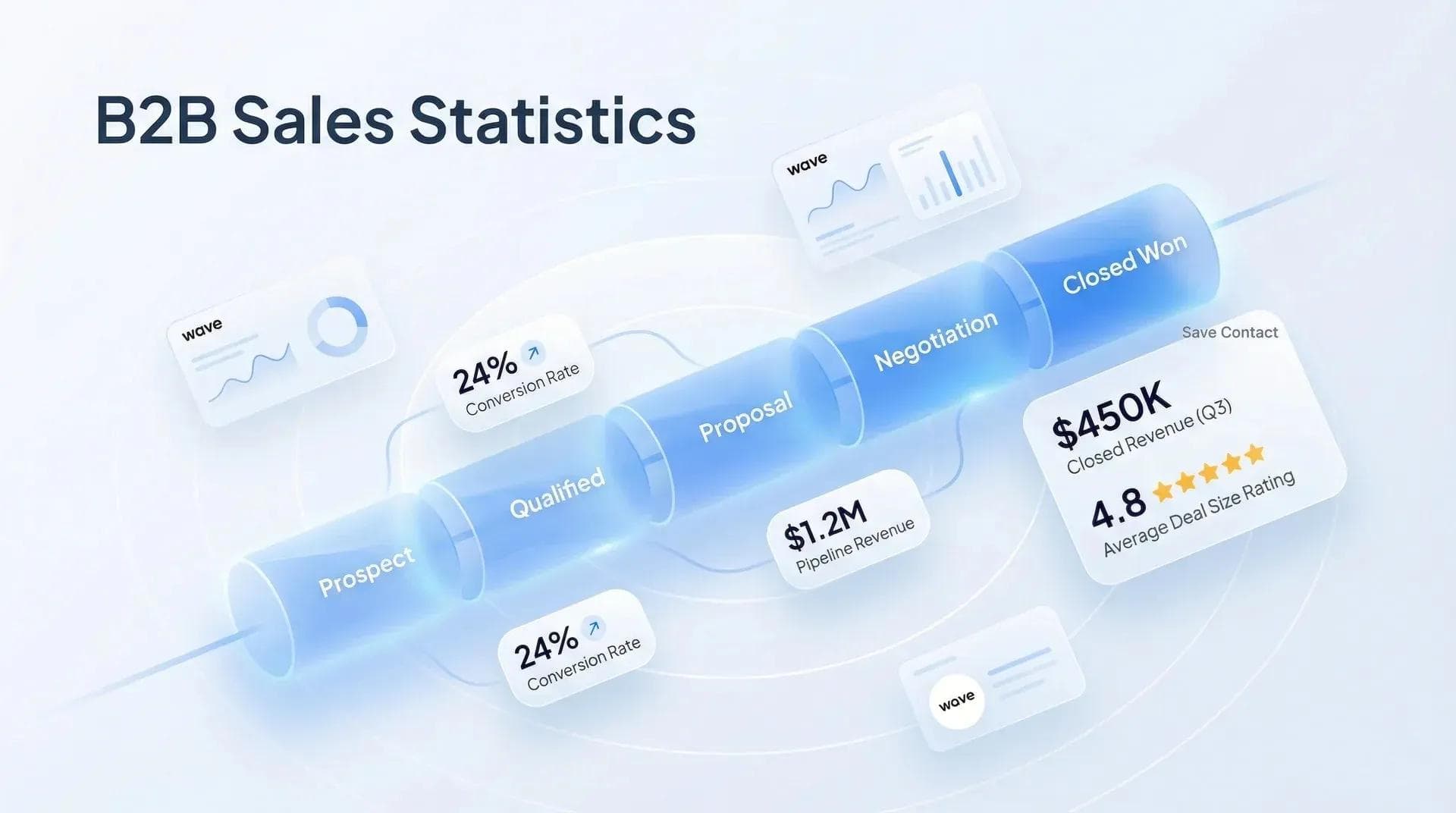
B2B sales statistics tell us something pretty clear right now: buyers are making decisions faster, AI is reshaping every stage of the funnel, and the teams that nail first impressions are winning more deals. I compiled 60+ of the most current business-to-business sales statistics and data points so you've got everything in one place.
Whether you're building a pitch deck, writing a strategy doc, or trying to convince your VP that your sales team needs better tools, these B2B sales stats are ready to copy and cite. Every number links back to its original source.
The B2B sales landscape in 2026 is defined by AI adoption (89% of revenue orgs now use it), compressed buying cycles (down to 10 months on average), and a follow-up crisis where 80% of trade show leads never get contacted. Buyers are 77% likely to purchase from the vendor they ranked first before ever talking to sales. Speed, digital-first contact exchange, and proactive selling habits now separate top performers from everyone else.
- Market size and scale: How big the B2B sales world actually is (hint: $36 trillion)
- Pipeline and close rates: What's realistic for conversion at each funnel stage
- Buyer behavior shifts: Why 94% of buying groups rank vendors before first contact
- AI adoption data: How sales teams are using AI and what's actually working
- Follow-up timing: The data behind the 5-minute rule (and why most teams blow it)
- Trade show and event stats: The lead capture gap no one talks about
Top B2B Sales Stats at a Glance
Here are the 10 B2B sales statistics that matter most in 2026, pulled from the full report below. These are the numbers sales leaders, marketers, and content creators cite most often. Each one is sourced and expanded in the relevant section.
| Stat | Data Point | Source |
|---|---|---|
| Global B2B eCommerce market | $36 trillion by 2026 | Trade.gov |
| AI adoption in sales orgs | 89% of revenue orgs use AI | G2, 2025 |
| Buyer shortlist loyalty | 77% buy from their Day 1 favorite | 6Sense, 2025 |
| Average B2B sales cycle | 10 months | 6Sense, 2025 |
| 5-minute response conversion | 21x more likely to convert | Setter AI / HBR |
| Trade show leads never followed up | 80% | Cvent, 2025 |
| Non-selling time for reps | 60% of time on admin tasks | Salesforce, 2026 |
| Reps who never follow up | 48% make zero follow-up calls | Flowlu / Invesp |
| Proactive seller revenue lift | 19-30% higher annual revenue | Emblaze, 2025 |
| B2B buyers using LLMs | 89% of purchases included AI features | 6Sense, 2025 |
B2B Sales Market Overview
The global B2B eCommerce market is on track to hit $36 trillion in 2026, dwarfing B2C by roughly 6x. That's not a typo. Business-to-business sales statistics consistently show a market that's massive in scale but still early in its digital transformation. Asia-Pacific dominates volume, but North American deal values remain the highest per transaction. Here's where things stand.
- $36 trillion - projected global B2B eCommerce market size by 2026, growing at a 14.5% CAGR (Trade.gov / International Trade Administration).
- $32.1 trillion - estimated global B2B eCommerce market value in 2025, up from $28.2 trillion in 2024 (Statista, 2025).
- $61.9 trillion - projected B2B eCommerce market size by 2030, more than doubling current levels (Straits Research).
- 80% of the global B2B market share comes from Asia-Pacific, driven by manufacturing, energy, and healthcare sectors (Trade.gov).
- 6x larger - the B2B eCommerce market is approximately six times the size of the B2C market, where global B2C revenue is expected to reach ~$5.5 trillion by 2027 (Experro / Statista).
- 39% of B2B buyers now spend over $500,000 per order through self-service eCommerce or remote interactions, up from 28% two years ago (McKinsey Global B2B Pulse).
For context on how digital is reshaping the broader business card and contact exchange space, check out our digital business card statistics roundup.
B2B Sales Pipeline and Funnel Statistics
The average B2B sales cycle now sits at 10 months, down slightly from 11 months in 2024, as AI-driven buyer research compresses the selection phase. But don't let that improvement fool you. Most of the pipeline is still a grind - win rates hover around 21%, nearly a third of reps miss quota, and 86% of B2B purchases hit at least one stall. The techniques that close deals haven't changed as much as the speed at which buyers disqualify vendors.
- 10 months - average B2B buying cycle length in 2025, shortened from roughly 11 months in 2024 (6Sense Buyer Experience Report, 2025).
- 21% - average B2B win rate across all pipeline stages (HubSpot State of Sales, 2024).
- 30% of B2B reps hit their quota in 2024, reflecting a challenging sales environment with tighter budgets and longer deal cycles (Sales So / Pavilion, 2024).
- 2.9% - median B2B lead-to-customer conversion rate, with most industries falling between 2.0% and 5.0% (Martal Group, 2026).
- 15% - average MQL-to-SQL conversion rate, making it the biggest single drop-off in most B2B funnels (Martal Group, 2026).
- 3-5x pipeline coverage is what most B2B teams need to reliably hit quota, with enterprise teams closer to 4-5x (Hyperbound, 2025).
- 60/40 split - the B2B buying journey now divides 60% selection and 40% validation, compressed from the previous 70/30 split as buyers need more time validating AI capabilities (6Sense, 2025).
B2B Prospecting and Lead Generation Statistics
Sales reps spend 40% of their time just finding people to sell to, and it takes an average of 8 call attempts to reach a single decision-maker. That's a lot of effort before a conversation even starts. Social selling has become the cheat code here - LinkedIn drives the vast majority of B2B social leads, and reps who use it consistently outperform peers who don't. The prospecting stats below show exactly where the time goes.
- 42% of sales reps say prospecting is the hardest part of their job, making it the #1 difficulty cited above closing and qualifying (SPOTIO / HubSpot, 2026).
- 40% of a rep's time is spent searching for the right prospects to call (Flowlu / InsideSales, 2026).
- 8 call attempts on average to reach a B2B decision-maker, and most reps give up before that (Cleverly, 2026).
- 80% of B2B social media leads come through LinkedIn (Martal / LinkedIn, 2026).
- 78% of social sellers outperform their peers who don't use social selling at all (Breakcold / LinkedIn Sales Solutions, 2025).
- 50-60% of B2B decision-makers still prefer phone contact for initial outreach (SPOTIO / RAIN Group, 2026).
- 2-5% conversion rate for cold calls in 2025, which is higher than cold email but requires significantly more rep time per contact (Sopro, 2026).
- 250% better results from multi-channel outreach (email + phone + social) compared to single-channel strategies (Sopro, 2026).
Your reps' tools and accessories matter here. Anything that cuts the time between "I met a prospect" and "I'm in their CRM" is a multiplier on prospecting efficiency.
Sales Follow-Up and Response Time Statistics
Leads contacted within 5 minutes are 21x more likely to convert than those contacted after 30 minutes, yet only 7% of companies actually hit that 5-minute window. This section is the one I keep coming back to because the gap between what works and what teams actually do is enormous. 📈 The follow-up data doesn't lie: speed wins deals, and most sales teams are leaving money on the table every single day.
- 21x more likely to convert when leads are contacted within 5 minutes versus 30 minutes (Setter AI / Harvard Business Review).
- 400% drop in qualification odds when response time extends from 5 to 10 minutes, based on an analysis of 100,000 call attempts (Chili Piper / HBR).
- 42 hours - average time it takes B2B sales teams to respond to a new lead. Yes, almost two full days (Setter AI, 2026).
- 48% of salespeople never make a single follow-up attempt after initial contact (Flowlu / Invesp).
- 7% of companies respond to leads within 5 minutes, despite the massive conversion advantage (Setter AI, 2026).
- 82% of buyers expect a response within 10 minutes of reaching out (Setter AI / Drift).
- 35-50% of sales go to the vendor that responds first (Setter AI / InsideSales.com).
- 38% of leads that receive a delayed response never reply at all, making that contact essentially dead (Setter AI, 2026).
💡 From My Experience: I've watched this play out at dozens of trade shows. A rep meets a great prospect, exchanges paper cards, and by the time they sit down to manually enter the info into their CRM, it's been 2-3 days. That prospect has already moved on. The teams that capture contact digitally and trigger follow-up workflows immediately are the ones I see closing deals from events.
B2B Buyer Behavior Statistics
94% of B2B buying groups rank their preferred vendors before they ever pick up the phone to talk to a sales rep, and 77% of the time they end up buying from that Day 1 favorite. If your team isn't on the shortlist early, you're not losing deals to competitors - you're not even in the race. The shift toward digital-first research and AI-assisted evaluation has compressed the window for influence. Here's how demos and touchpoints fit into the modern buyer journey.
- 94% of buying groups ranked their preferred vendors before first contact with sales, and they bought from that favorite 77% of the time (6Sense Buyer Experience Report, 2025).
- 5.1 vendors evaluated on average per B2B purchase in 2025, up from 4.5 the year before (6Sense, 2025).
- 3.8 out of 5 vendors on a buyer's shortlist are ones they've had prior experience with, up from 3.2 in previous years (6Sense, 2025).
- 13 internal stakeholders + 9 external influencers are involved in a typical B2B buying decision in 2026 (Forrester, 2026).
- 61% of B2B buyers prefer a purchasing experience that doesn't involve a sales rep (Gartner).
- 75% of B2B buyers say they'd rather make complex purchases digitally than in person (McKinsey).
- 60%+ of B2B buyers engaged in some form of trial (free pilots, sandbox environments, usage-based trials) before committing to a full purchase (Forrester, 2026).
- 58% of buyers engaged sellers earlier in 2025 specifically to clarify missing AI-related details (6Sense, 2025).
AI and Sales Technology Adoption Statistics
AI adoption in B2B sales has exploded to 89% of revenue organizations, up from just 34% in 2023, and the performance gap between AI users and non-users keeps widening. 🤖 This isn't hype anymore. Salesforce's 2026 report says investing in AI is the #1 tactic sales leaders cite for growth. Meanwhile, buyers themselves are using LLMs to evaluate vendors, creating a whole new dynamic where both sides of the table are AI-assisted.
- 89% of revenue organizations have adopted AI, up from 34% in 2023 (G2, 2025).
- 92% of companies plan to increase their AI investments over the next three years (Sopro / Salesforce, 2026).
- 89% of B2B purchases in 2025 included AI features as part of the solution (6Sense Buyer Experience Report, 2025).
- 60% of sales reps' time goes to non-selling tasks like hunting for pitch decks and manually entering customer notes (Salesforce State of Sales, 2026).
- 20% of B2B sellers will be compelled to respond to AI-powered buyer agents with dynamically delivered counteroffers in 2026 (Forrester 2026 Predictions).
- $10 billion+ in losses predicted for B2B companies from ungoverned use of generative AI in 2026 (Forrester 2026 Predictions).
- 3.7x more likely to meet quota for sales teams using AI tools vs. those that don't (Salesforce, 2026).
- 54% of sellers say they've used AI agents, and nearly 9 in 10 plan to by 2027 (Salesforce State of Sales, 2026).
- 19% of buyers using AI feel less confident in their purchasing decisions due to inaccurate AI output (Forrester, 2026).
Remote and Virtual Selling Statistics
80% of B2B sales interactions now happen through digital channels, and companies using hybrid sales models see up to 50% higher revenue than those sticking with just one approach. The shift to virtual selling that started during COVID has become permanent. Inside sales costs a fraction of field sales, buyers prefer remote interactions for most purchasing stages, and eCommerce has overtaken in-person sales as the top revenue channel for B2B companies that offer it.
- 80% of B2B sales interactions between suppliers and buyers now occur in digital channels (Gartner).
- 10+ channels used by B2B buyers in any given purchase, double the number from five years ago (McKinsey B2B Pulse).
- 50% higher revenue for companies using hybrid sales models compared to single-approach companies (McKinsey, 2023).
- Two-thirds of B2B buyers and sellers prefer remote interactions to in-person at most purchasing stages (McKinsey B2B Pulse).
- 9 out of 10 B2B companies plan to maintain hybrid sales models, making it the default strategy for 2026 (McKinsey).
- Inside sales reps cover 4x more prospects at half the cost compared to outside sales reps (McKinsey).
- 30% of B2B sales cycles will be managed through digital sales rooms by 2026 (Gartner).
Sales Rep Performance and Productivity Statistics
Proactive sellers generate 19-30% higher annual revenue and win at nearly double the rate of reactive sellers, yet 69-83% of opportunities still come from buyer-led (reactive) sources. That's the productivity paradox in B2B sales right now. The reps who go out and create opportunities massively outperform those who wait for inbound - but most organizations are still built around the reactive model.
- 19-30% higher annual revenue for proactive sellers compared to reactive peers (Emblaze Revenue Summit, 2025).
- 12-23% higher profit margins for proactive sellers versus reactive ones (Emblaze, 2025).
- 33-41% win rate for proactive (seller-initiated) opportunities versus just 18-25% for reactive (buyer-initiated) opportunities (Emblaze, 2025).
- 69-83% of B2B sales opportunities are reactive and buyer-led, highlighting a major untapped opportunity for proactive outreach (Emblaze, 2025).
- 43% average quota attainment across all B2B sales roles in Q4 2024, with enterprise AEs at just 38.2% (Sales So / Pavilion, 2024).
- 35% increase in deal size when reps use social selling techniques, linking LinkedIn activity directly to larger contracts (Breakcold / LinkedIn Sales Solutions).
- 68% of sales reps report that AI insights directly help them close deals faster (Sopro, 2026).
B2B Sales at Trade Shows and Events
81% of trade show attendees have buying authority, making events one of the highest-quality lead sources available - yet 80% of those leads never receive follow-up. That gap is staggering. 🎟️ Trade shows aren't cheap (the average cost per lead is $112), so losing 4 out of 5 leads to poor follow-up processes is essentially burning money. This is the section no competitor covers, and frankly, it's the one that matters most to networking ROI.
- 81% of trade show attendees have buying authority, making them among the most qualified prospects available (Cvent, 2025).
- 80% of trade show leads never receive any follow-up from the exhibiting company (Cvent, 2025).
- 67% of trade show attendees represent a brand-new prospect for the exhibiting company (Cvent, 2025).
- $112 average cost per lead at a trade show, compared to $259 for a traditional field sales call (Cvent, 2025).
- 39% of exhibitors now use RFID or NFC badges for lead capture at events (Dreamcast, 2026).
Think about it: you've got the most qualified prospects in the room, they cost less per lead than any other channel, and most teams lose them because they're still relying on paper cards and manual data entry. That's where digital business cards for sales teams are changing the equation.
Wave Perspective: What These Stats Mean for Contact Exchange
These 60+ B2B sales statistics point to a clear pattern: the moments that matter most happen before the formal sales process even begins.
Let's connect the dots.
Buyers rank their preferred vendors before they ever talk to a rep (stat #30). Leads contacted within 5 minutes are 21x more likely to convert (stat #22). And yet 80% of trade show leads get zero follow-up (stat #62), while the average B2B team takes 42 hours to respond to a new lead (stat #24).
So where's the breakdown? It's in the contact exchange step - that first moment when a prospect gets your information and you get theirs. Paper business cards create a delay. Manual data entry creates a bigger delay. And every minute of delay craters your conversion probability.
The smart sales teams I work with have figured this out. They're using digital business cards to make the contact capture instant: no typing, no lost paper cards, no 48-hour gaps before the first follow-up. When a rep shares their info digitally, it syncs to CRM immediately, which means follow-up workflows trigger while the conversation is still warm.
Here's what the data tells us about where contact exchange fits:
- The 5-minute rule is real - but you can't respond in 5 minutes if you're spending 2 days manually entering contacts from a stack of paper cards.
- 60% of rep time on admin (stat #41) includes manual contact entry. Digital tools cut that to seconds.
- 67% of the buying journey is digital - which means your digital card IS your first impression for most prospects.
- 80% of trade show leads lost - primarily because paper cards get buried, contacts don't make it into CRM, and by the time someone follows up, the window has closed.
At Wave Connect, we've seen this play out across thousands of sales team deployments. The teams that eliminate the paper-to-CRM gap don't just follow up faster - they follow up at all. And based on the data in this report, that alone puts them ahead of 80% of their competition.
Frequently Asked Questions
What is the average B2B sales cycle length?
The average B2B sales cycle is approximately 10 months as of 2025, down from 11 months in 2024. Enterprise deals with larger buying committees can stretch to 12+ months (6Sense Buyer Experience Report, 2025).
How many follow-ups does it take to close a B2B sale?
Most B2B deals require at least 5-8 follow-up touchpoints to close. Despite this, 48% of salespeople never make a single follow-up attempt after initial contact (Flowlu / Invesp).
What percentage of B2B sales are done online?
Approximately 80% of B2B sales interactions now occur through digital channels. Self-service eCommerce has overtaken in-person as the top revenue-generating channel for companies that offer it (Gartner; McKinsey).
How is AI changing B2B sales in 2026?
89% of revenue organizations now use AI, and teams using AI tools are 3.7x more likely to hit quota. Both sellers and buyers are using AI - with 89% of B2B purchases now including AI features in the solution (Salesforce, 2026; 6Sense, 2025).
What is the biggest challenge in B2B sales today?
Prospecting and response speed are the two biggest challenges. 42% of reps cite prospecting as their #1 difficulty, while the average lead response time of 42 hours is far too slow for buyers who expect replies within 10 minutes (HubSpot; Setter AI, 2026).
How do B2B buyers find new vendors?
B2B buyers use 10+ channels during any given purchase, with prior experience being the strongest factor. 3.8 out of 5 vendors on the average shortlist are ones the buyer already knows (6Sense, 2025; McKinsey).
What is the average B2B close rate?
The average B2B win rate is approximately 21%, with top performers reaching 30%+. After a formal proposal is sent, win rates improve to 31-50% for half of B2B companies (HubSpot, 2024; Norwest, 2024).
Give Your Sales Team the Follow-Up Speed They Need
Digital business cards that sync to CRM instantly. No app required for contacts. Bulk deploy your entire team in minutes.
Explore Wave for TeamsAbout the Author: George El-Hage is the Founder of Wave Connect, an event lead capture platform with a full digital business card built in, serving 200,000+ professionals worldwide. With 6+ years helping B2B sales teams modernize contact exchange, George has deep expertise in how digital tools accelerate pipeline velocity and follow-up speed. Wave Connect is SOC 2 Type II compliant and integrates with leading CRM platforms like Salesforce, HubSpot, and Pipedrive. Connect with George on LinkedIn.