Financial Advisor Marketing Ideas That Work (2026)

George El-Hage

George El-Hage March 14, 2026 · 18 分钟阅读
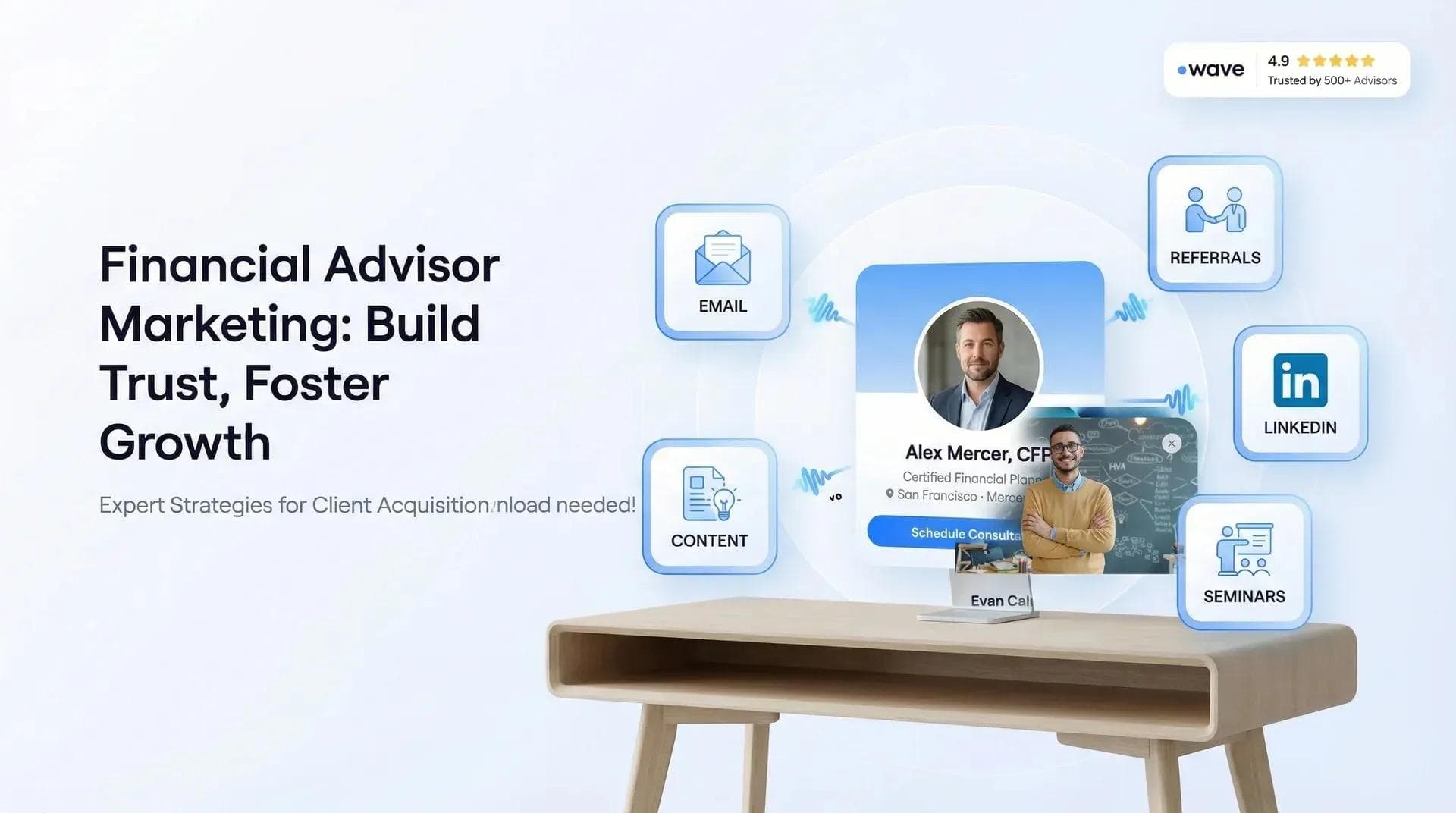
Financial Advisor Marketing Ideas
⚡ Last Updated: February 23, 2026 | Written By: George El-Hage | Reading Time: 11 min
George El-Hage
Founder, Wave Connect | Trusted by 10,000+ teams globally

I've worked with financial advisors, wealth management firms, and insurance teams deploying digital business cards and networking tools. This guide is based on what I've seen actually move the needle for advisory practices - not theory.

Financial advisor marketing ideas don't have to be complicated - but most advisors overthink it or don't do it at all. According to a Broadridge survey, only about 23% of financial advisors have a defined marketing strategy. That means nearly 4 out of 5 advisors are relying on word-of-mouth, gut instinct, or nothing at all.

In this guide, I'll walk you through 15 marketing ideas that actually work for financial advisors in 2026 - from building a referral engine to using digital tools that help your team stand out. I've helped financial services teams modernize how they connect with clients and prospects, so this is based on real conversations, not just marketing theory.

TL;DR

The best financial advisor marketing ideas combine referral systems, content marketing, local presence, and modern digital tools. Referrals remain the top client acquisition channel, but advisors who add LinkedIn content, educational seminars, and a strong digital presence grow faster. Compliance doesn't have to kill creativity - it just requires planning. Start with 2-3 ideas from this list, execute them consistently for 90 days, and measure what's working before adding more.

What You'll Learn

  • Referral systems: How to turn referrals from random to repeatable with COI partnerships and tracking
  • Content + social: The LinkedIn and email strategies that build trust before the first meeting
  • Local marketing: Seminars, community groups, and local partnerships that still work in 2026
  • Digital presence: Website, Google Business Profile, and networking tools that make you memorable
  • Compliance: SEC and FINRA marketing rules explained in plain English (most guides skip this)

Why Most Financial Advisor Marketing Fails (And What Actually Works)

Most financial advisor marketing fails because advisors treat it as a one-off project instead of a consistent system. They'll sponsor one golf tournament, post on LinkedIn twice, send a quarterly newsletter, and then wonder why nothing's working. The advisors who grow steadily don't do more marketing - they do fewer things consistently. Pick 2-3 channels, commit to them for at least 90 days, and track what brings in meetings. That's the entire strategy.

Here's the thing - financial advisors are phenomenal at building financial plans, but most never received a single hour of marketing training. And the marketing advice that's out there? It's usually written for tech startups or e-commerce brands. Running Facebook ads to sell retirement planning doesn't work the same way as selling sneakers. 😬

What I've seen work across the financial services teams I've talked to comes down to three pillars: relationships (referrals and networking), credibility (content and digital presence), and consistency (showing up repeatedly in the same channels). The rest of this guide breaks down specific tactics within each pillar.

Build a Referral Engine (Not Just a Referral Request)

Referrals are still the number-one client acquisition channel for financial advisors, but most advisors leave them entirely to chance. A referral engine means building a system around asking, tracking, and rewarding referrals instead of hoping clients mention you to their friends. The advisors who grow fastest create formal Centers of Influence (COI) partnerships with CPAs, estate attorneys, and insurance agents - professionals who serve the same clients but don't compete with you.

Here's what separates a referral request from a referral engine:

  • Timing matters: Ask for referrals after a positive milestone - when you've helped a client hit a savings goal, completed a financial plan, or resolved a tax situation. Don't ask during onboarding when they barely know you.
  • Make it specific: "Do you know anyone who might need financial planning?" gets you nothing. Try: "Do you know any business owners who've mentioned they're thinking about selling in the next 5 years?" Specificity gives people a face to attach to the request.
  • COI partnerships are gold: Build real relationships with 3-5 CPAs and estate attorneys. Take them to lunch. Send them referrals first. When a CPA's client asks "do you know a good financial advisor?" - you want your name to be automatic.
  • Advisor Compliance
  • Track your sources: Know which clients and COI partners send you the most referrals. Double down on those relationships. A simple spreadsheet works fine.

If you want more on building professional relationships that drive referrals, I wrote a deeper piece on how networking drives career growth - a lot of the same principles apply to advisor-client referral networks.

💡 From My Experience: One wealth management firm I worked with tracked their client acquisition sources for a full year. Referrals from three CPA partners accounted for 40% of their new clients. They weren't doing anything fancy - just consistent monthly lunches and a mutual referral agreement. The system was simple, but it was a system, not a hope.

Content Marketing That Builds Trust Before the First Meeting

Content marketing for financial advisors works because it answers the questions your prospects are already Googling - before they ever call you. Blog posts about tax planning, retirement timelines, and estate basics position you as the expert who educates, not sells. The "teach, don't sell" framework is simple: give away your knowledge freely, and people will pay you for the implementation. An advisor who publishes one helpful article per month builds more trust than one who runs ads every day.

The best content topics come straight from your client meetings. What questions do clients ask you every single week? Those are your blog posts, your newsletter topics, and your LinkedIn content.

Here are the content types that work for advisors:

  • Educational blog posts: "How much do I need to retire at 60?" or "Roth conversion strategies for 2026" - practical answers to real questions
  • Email newsletters: Monthly market commentary with personal perspective. Not a Wall Street research note - your take on what it means for your clients specifically
  • Client case studies (anonymized): "A couple came to me with $500K in a 401(k) and no plan. Here's how we built a retirement timeline together." Real stories build trust better than any testimonial
  • Repurpose everything: One blog post becomes a LinkedIn post, an email section, a seminar talking point, and a short video. Don't create from scratch every time

The key? Consistency beats perfection. A mediocre newsletter that goes out every month will outperform a brilliant one that goes out twice a year.

Social Media for Financial Advisors (LinkedIn Is Your Best Friend)

LinkedIn is the single most effective social media platform for financial advisor marketing because your ideal clients - high-net-worth professionals and business owners - are already there. Research from Kitces.com shows that financial advisors who use social media consistently report higher client acquisition rates. You don't need to be on every platform. Master LinkedIn first - everything else is optional.

Here's what to post (and what not to):

  • Market commentary with your opinion: "The Fed held rates steady yesterday. Here's what that means for people planning to retire in the next 5 years." Add your perspective, not just the news.
  • Client wins (anonymized): "Helped a client realize they could retire 3 years earlier than they thought by restructuring their portfolio. Moments like this are why I do this work."
  • Educational content: Quick tips on tax planning, Social Security strategies, or estate planning basics. Teach something useful in 200 words or less.
  • Personal stories: Why you became an advisor. A lesson you learned the hard way. Something about your weekend. People hire people, not credentials.
Advisor Content Marketing

Post 2-3 times per week. Comment on 5-10 posts from people in your network every day. That's the algorithm hack - engagement on other people's content matters as much as your own posts.

For more on building your professional presence online, check out our guide on personal branding - the principles apply directly to financial advisors building a digital reputation. 🔥

Seminar and Workshop Marketing (The Old-School Tactic That Still Works)

Educational seminars remain one of the highest-converting marketing channels for financial advisors because they let prospects experience your expertise firsthand before any sales conversation. Topics that fill seats include Social Security optimization, retirement income planning, tax-efficient withdrawal strategies, and estate planning basics. The seminar itself is the marketing - you're not pitching, you're teaching. And people who sit through a 90-minute workshop on retirement planning are self-selecting as serious prospects.

Here's how to make seminars actually work in 2026:

  • Pick topics that solve urgent problems: "Social Security: When to Claim and How to Maximize Your Benefits" fills more seats than "Comprehensive Financial Planning Overview." Be specific.
  • Partner for promotion: Local libraries, community centers, and employer HR departments will promote your event to their audience for free if it's educational. Auto dealerships and other local businesses often co-host financial wellness events for their employees.
  • Capture attendee info digitally: Paper sign-in sheets are messy and hard to read. Use a digital sign-in or QR code system so you can follow up the same day with clean data.
  • The pipeline: Seminar → thank-you email (same day) → free one-on-one consultation offer → prospect meeting → client onboarding. Map this out before your first event.

I've seen financial services teams switch from paper handouts and printed sign-in sheets to digital tools at seminars - the follow-up rate went up significantly just because they could actually read people's contact information and reach out the same evening.

Community Presence and Local Marketing

Local marketing works for financial advisors because trust is built through repeated visibility in your community, not through a single ad or mailer. Sponsoring a local charity run, joining the Rotary Club, or hosting a "financial wellness" lunch-and-learn for a local employer puts your face in front of the same people multiple times. That familiarity breeds trust - and trust is the currency of financial advisory relationships.

  • Join 1-2 business groups: Chamber of Commerce, BNI, or Rotary. Pick one and show up consistently. The advisors who treat these as one-time networking events get nothing. The ones who attend every meeting for a year become the go-to financial advisor in the group.
  • Sponsor strategically: Don't spread $5,000 across 10 events. Put it into 2-3 events where your ideal clients actually show up. A charity golf tournament for a local business association? Yes. A random 5K nobody in your target market runs? Probably not.
  • Partner with complementary professionals: CPAs, insurance agents and brokers, estate attorneys, and realtors all serve the same clients you do. Joint workshops, co-branded newsletters, and mutual referral agreements are free marketing with built-in credibility.
  • Employer financial wellness programs: Offer to run a free lunch-and-learn on retirement planning or budgeting for local companies. HR departments love bringing in outside experts, and you get a room full of people who need financial advice.

Your Digital Presence Is Your First Impression

Your website, Google Business Profile, and online reviews are the first things a potential client sees - often before they ever talk to you. When someone gets a referral to a financial advisor, the first thing they do is Google you. If your website looks like it was built in 2012, your Google profile has no reviews, and you don't show up in local search, you're losing clients before the conversation starts. A clean website with a clear value proposition, an optimized Google Business Profile, and 10+ client reviews will do more for your practice than most paid advertising.

Advisor Digital Presence
  • Website basics: Clear headline explaining who you serve and how. An easy way to schedule a consultation (Calendly link, not a contact form that goes to a shared inbox). Mobile-friendly design. Your credentials visible but not the main focus.
  • Google Business Profile: Claim it, fill out every field, post updates monthly, and actively ask satisfied clients to leave reviews. For local financial advisors, this is the single most underrated marketing tool.
  • SEO for advisors: You don't need a massive content operation. Start by creating one page per service you offer ("retirement planning in [your city]," "financial advisor for business owners in [your city]"). Local + service keywords are realistic to rank for.
  • Online reviews: The SEC Marketing Rule (adopted in 2022) now allows advisors to use client testimonials and endorsements - with proper disclosures. This was a huge change. If you're not collecting Google reviews, you're leaving credibility on the table.

For more on how professionals in regulated industries are updating their digital presence, check out our guide for lawyers using digital business cards - a lot of the same compliance-meets-digital challenges apply.

💡 From My Experience: I've worked with financial services teams who needed compliance-friendly digital tools - SOC 2 certification and data privacy were non-negotiable for them. One advisory firm told me they'd been using the same business card design since 2015. When they finally updated to digital, their clients actually commented on it during meetings. Small changes to your digital presence signal that you're current and detail-oriented - qualities clients want in someone managing their money.

Networking Tools That Make You Memorable

The best networking tool for a financial advisor is one that captures contact information instantly, looks professional, and works without asking the other person to download anything. Paper business cards get lost, go stale when your phone number or title changes, and give you zero data on who actually saved your info. Digital business cards solve all three problems - you share via QR code or NFC tap, the recipient saves your info in seconds, and you get a record of every connection.

Advisor Referral Engine

Think about where financial advisors actually meet prospects: client lunches, golf outings, charity events, seminars, industry conferences, and community meetings. In every one of those situations, you need a fast, professional way to exchange contact info that doesn't feel clunky.

Here's what I'd look for in a digital networking tool if I were running a financial advisory practice:

  • No app required for recipients: If someone has to download an app just to get your contact info, most won't do it. The tool should work in their phone's browser instantly.
  • SOC 2 Type II certification: Financial services firms deal with sensitive client data. Your networking tool should meet the same security standards as your other software. This isn't optional in regulated industries.
  • Team management dashboard: If you have multiple advisors, you need to manage everyone's cards centrally - update branding, add new team members, and ensure consistency without chasing individuals.
  • CRM integration: New contacts should flow into your CRM automatically. No manual entry, no lost contacts, no gaps in your follow-up system.
  • QR codes on everything: Put them on your email signature, presentation decks, seminar handouts, and office signage. Every touchpoint becomes a contact capture opportunity.

I've seen real estate agents and financial advisors have nearly identical needs here - both work in relationship-driven, compliance-heavy industries where first impressions matter enormously. If you're managing a team, Wave Connect's team platform was built for exactly this use case.

Email Marketing That Doesn't Feel Like Spam

Email marketing for financial advisors works when it's permission-based, genuinely useful, and consistent - not when it's a monthly sales pitch disguised as a newsletter. The advisors with the best email engagement rates share market insights with personal commentary, practical tax tips tied to the calendar (Q4 Roth conversions, year-end charitable giving), and firm updates that feel like a letter from a trusted friend. Build a list of clients, prospects, and COI partners, and send something valuable every 2-4 weeks.

  • Newsletter formats that work: Market update (2-3 paragraphs with your take) + one planning tip + one personal note. Keep it under 500 words. People scan, they don't read essays.
  • Automated drip sequences: When someone downloads a guide from your website or attends a seminar, they should get a series of 3-5 emails over 2-3 weeks. Not sales emails - educational ones that demonstrate your expertise.
  • Metrics that matter: Open rates above 30% are good for financial services. Click rates above 3% mean people are engaging. But the metric that actually matters? Meetings booked. Track how many email recipients schedule a consultation each month.

Email is also a great place to embed your digital contact info. Recruiters and HR teams have seen huge results from adding digital business card links to email signatures - the same tactic works for advisory firms where every email is a chance to make it easy for someone to save your info or share it with a friend.

Compliance Considerations for Financial Advisor Marketing

Compliance doesn't kill financial advisor marketing - it just means you need to plan before you post. The two big regulatory bodies are the SEC (for RIAs) and FINRA (for broker-dealers), and both have updated their marketing rules in recent years. The SEC Marketing Rule (effective November 2022) was a major modernization that now allows testimonials, endorsements, and performance advertising - with guardrails. FINRA Rule 2210 governs communications with the public for broker-dealers, covering social media, websites, and advertising.

Here's what you need to know in plain English:

SEC Marketing Rule (for RIAs)

  • Testimonials and endorsements are now allowed - but you must disclose whether the person was compensated, whether they're a current client, and include any material conflicts of interest
  • Performance advertising has specific rules about net vs. gross returns, time periods, and benchmarks. Don't wing this - work with your compliance officer
  • Social media posts count as advertisements if they offer investment advice or promote your services. That LinkedIn post about market trends? Probably an ad in the SEC's eyes

FINRA Rules (for Broker-Dealers)

  • All communications must be fair and balanced - you can't cherry-pick performance data or make promises about future results
  • Social media archiving is required. Every LinkedIn post, every tweet, every comment needs to be captured and stored. Use a compliant archiving tool
  • Third-party content you share (articles, studies) can be treated as your own communication if you endorse it. A simple "interesting read" share is usually fine. Adding "I recommend this strategy" makes it an endorsement

Practical Compliance Tips

  • Build a review workflow: Create 2-3 templates for common post types (market commentary, educational tips, event promotions) and get them pre-approved by compliance. Then swap in current details without re-reviewing the entire structure.
  • Keep records of everything: Screenshots of social posts, copies of emails, seminar materials, website archives. If you can't prove what you said and when, you're exposed.
  • Don't let compliance paralyze you: Some advisors avoid marketing entirely because they're afraid of a compliance violation. That's letting fear win. Most marketing activities are fine with basic disclosures and balanced language.
💡 From My Experience: When I work with financial services teams, compliance is always the first conversation - not an afterthought. One firm I worked with built a "compliance-approved content library" of 20 social media post templates. Their advisors could customize the details but the structure and disclaimers were pre-approved. They went from posting zero times a month to 3 times a week per advisor, all within compliance. The bottleneck was never creativity - it was process.

Frequently Asked Questions

How much should a financial advisor spend on marketing?

Most industry benchmarks recommend 2-5% of revenue for marketing. Solo practitioners on the lower end, growing firms on the higher end - especially when investing in content, events, and digital tools.

What is the best social media platform for financial advisors?

LinkedIn is the clear winner for financial advisors. Your ideal clients - high-net-worth professionals and business owners - are active there, and the platform rewards educational content.

How do financial advisors get more clients?

The three highest-converting channels are referrals, content marketing, and a strong digital presence. Build a referral system, publish helpful content consistently, and make sure your website and Google profile are optimized.

Are financial advisors allowed to advertise?

Yes - the SEC Marketing Rule (2022) modernized advertising rules for RIAs, and FINRA has clear guidelines for broker-dealers. Testimonials, endorsements, and social media are all allowed with proper disclosures.

What marketing tools do financial advisors use?

The core stack is a CRM (Redtail, Wealthbox), email platform (Mailchimp, Constant Contact), social media scheduler, and digital business cards for networking. Start simple and add tools as you grow.

How do I market myself as a new financial advisor?

Pick a niche (business owners, doctors, teachers), create content for that audience, and build local relationships through community groups and COI partnerships. Niche advisors grow faster because referrals are more specific.

Give Your Financial Advisory Team a Digital Edge

Digital business cards with SOC 2 Type II security, team management dashboard, and CRM integration. Built for compliance-focused industries.

Explore Wave for Teams

About the Author: George El-Hage is the Founder of Wave Connect, a digital business card platform serving 150,000+ professionals worldwide. With 6+ years helping organizations transition from paper to digital networking, George has worked with financial services teams, insurance agencies, and other regulated industries to deploy compliance-friendly digital tools. Connect with him on LinkedIn.

推荐文章